VOICE FAQs

This page provides answers to the most frequently asked questions about the VOICE method, divided into three sub-categories – methodology, impact and reporting – as well as a space for you to ask questions or make comments.


Frequently Asked Questions

METHODOLOGY

The VOICE method does not specify how often the results associated with a particular objective should be measured. However, it does stipulate that the deadline for the objective must be set in advance and that reporting on the achievement of the objective must be carried out at least in line with this deadline. The engager is nevertheless expected to regularly review the progress of their various engagement objectives and the actions to be implemented in case where an engagement fails to progress.

The method was developed in response to an observation: engagement practices are currently not sufficiently standardised, sometimes leading to engagement reporting that focuses on quantity rather than quality. In this context, the VOICE method provides tools to help shift the focus towards quality: engagement must include one or more formalised objectives that are monitored over time, and the request must be substantiated and contain an explicit expectation of interaction with the company on the issue. Furthermore, through the proposed influence scale in particular, the VOICE method enables the resources allocated to be accounted for in relation to the results achieved. It therefore provides an opportunity for the engagers to explain, beyond the mere number of engagements, the effectiveness of their engagements. It is also important to clearly distinguish between dialogues (particularly those aimed at gathering existing information) and engagement.

As the VOICE method provides for several levels of objectives (transparency, operational and strategic) and levels of influence (no influence to recognised influence), it does not prevent organisations from making a significant number of engagements if the approach adopted by the engager places importance on the quantity of engagements made.

In summary, VOICE aims 1/ to facilitate the comparability of engagement reporting by harmonising definitions and accounting scales (e.g. influence measured at the level of the engagement’s objective), and 2/ to highlight the resources allocated in relation to the results achieved.

It should be noted that three categories (signal, contributory, transformation) serve to link three dimensions developed in the study: the ambition of the objective, the level of influence of the engager, and the role of the engager within a coalition (see pp. 22 and 32 of the report). This categorisation therefore captures the efforts made by the engager and not merely the outcome.

It does not seek to rank the different types of engagement but is rather a means of providing an overview of the engagements undertaken according to levels of ambition, influence and role within the coalition.

Each category of engagement is considered important and worthy of recognition, as transformative engagement is sometimes only possible following signal or contributory engagement.

This categorisation can be used by asset owners, asset managers and engagers in general to gain a comprehensive overview of their engagement practices.

It should be noted that the framework was designed to cover all engagement activities carried out with a company, regardless of whether the investor is a bondholder or a shareholder.

All engagement activities, whether they take place in the context of annual general meetings, are covered by the VOICE method.

However, the act of voting itself is not counted as an engagement activity if it does not form part of an iterative and intentional cycle of interactions with the company, involving an objective set-in advance by the investor or engagers (see the definition of engagement, pp. 3 and 6 of the report). And so on, a simple vote against a resolution, if it does not form part of a broader engagement process, cannot be counted as an engagement activity.

However, the method provides that actions taken at annual general meetings, such as voting against a resolution, may be counted as escalation measures if they are linked to a pre-existing engagement (see categories in the reporting tool, p. 21 of the report).

The VOICE method’s definition of engagement clearly distinguishes engagement from dialogue. Dialogue is defined as a form of interaction with companies—whether occasional or recurring—that is open in nature, generally for the purposes of gathering information or building knowledge, and whose objective is not to bring about change within the company. 

The VOICE method does not deny the value of dialogue activities, which, for example, enable investors to gather information useful for analysing the risk profile of the company in which they have invested, to better understand the company’s context, and also to build a relationship of trust with the company over time (the establishment of a dialogue channel being one of the outputs of engagement, for instance). Dialogue activities therefore often contribute to the chances of success of an engagement and, when they are part of a structured engagement process, can be counted towards the ‘number of activities’ (see definition of activities on p. 7 and reporting on p. 21). 

Asset managers can train the various employees involved in engagement activities so that they incorporate the key principles of the VOICE method. 

The operational application of the method does not require development of new tools; it can be carried out using an Excel spreadsheet, facilitating monitoring from the launch right through to the final reporting for each engagement. 

Furthermore, the framework enables the optimisation of resource allocation and allows a focus on engagements that are more likely to succeed (e.g. identifying converging loops). Finally, the method also covers collaborative engagements, which can be an effective way of participating in engagements despite limited resources.  

This framework has been designed to facilitate the collection of data relating to engagement activities by asset owners : once adopted, the framework will enable asset managers to reduce the time spent preparing reports that vary from one client to another.    

Companies were not consulted during this initial phase of the work (2025–2026). However, the ESG workshops held as part of the FIR’s activities between investors and companies during 2025 provided the insights and reflections that led to the development of the VOICE method. Furthermore, discussions are currently taking place via various market networks and organisations (ORSE, Global Compact, Euronext, etc.). Finally, companies will also have the opportunity to ask questions and submit comments via the FAQs section on the FIR website. 

At this stage, VOICE is not intended to assess advocacy activities. However, the approach could be extended to assess the effectiveness and influence of engagement initiatives with sovereign issuers.

It should be noted that the framework was designed for all engagement activities carried out with a company, regardless of whether the investor is a bondholder or a shareholder.

Stewardship codes aim to provide a framework for active shareholding practices that go beyond engagement alone. They are not intended to impose a specific approach to engagement but do require signatories to be transparent about how they implement their approaches. The principles of stewardship codes are generally not very prescriptive or detailed regarding how signatories should report on their engagement activities. The VOICE method is therefore a useful complement to help signatories improve the quality of the information provided in their stewardship or engagement reports and to harmonise practices, particularly in terms of reporting, thereby promoting comparability.

To encourage asset managers to adopt the VOICE method, an asset owner has two main levers at its disposal:

– Strengthening the monitoring of engagements made by asset managers and revising the expected reporting format
– Identifying their own needs whilst raising awareness amongst asset managers of the need for standardised and clear information.

The adoption of a single reporting format and accounting system by all asset managers will enable asset owners using delegated asset management to consolidate all engagement activities carried out on their behalf into a single document.

INFLUENCE

Any investor or service provider who engages a company with the aim of exerting influence is referred to as an ‘engager’. An investor may engage a company directly or indirectly, via a service provider or an asset manager. In the latter case, the service provider or asset manager will be designated as the ‘engager’. It is therefore the ‘engager’ who must measure and report on their level of influence. The investor, for their part, may assess this reporting carried out on their behalf by the ‘engager’.

The difficulty in measuring the effects of engagement activities on corporate practices was one of the observations that lead to the launch of this work. Based on this observation, the working group has endeavoured to develop tools to better understand the link between these engagement activities and change within a company (see the concept of ‘output’p. 3 of the report) and thus to objectify the measurement of influence as much as possible.

The aim of measuring influence – by examining the link between engagement activities and the results achieved against set objectives – is to better assess the added value brought about by engagement when a result has been achieved. This measurement of influence is based on measurable and verifiable elements (e.g. achievement of a result, the existence and number of follow-up activities, a description of the discussions, relational dynamics enabling a compromise solution, stakeholders met, etc.).

However, measuring influence using the VOICE method does not seek to systematically attribute the achievement of an outcome to the engagement activity carried out by a particular investor, since in most cases, the achievement of an outcome depends on a multitude of internal and/or external factors and pressures.

Finally, evidence of influence – which seeks to assess the probability that the engagement contributed to the achievement of an outcome – is only required by VOICE from level 4, which is described as ‘very likely influence’. Only a minority of engagements – those at the ‘very likely’ and ‘recognised’ levels of influence – are subject to a request for detailed justification of the level of influence, and such cases remain rare.

It should be noted that the three categories (signal, contributory, transformative) enable us to link three dimensions developed in the research:

– the ambition of the objective,
– the level of influence of the engagement,
– the engager’s role within a coalition (see pp. 22 and 32 of the report).

This categorisation makes the scope of the engagement dependent not only on the level of influence but also on the role within a coalition and the ambition of the objective. It therefore captures the efforts made by the engager and not merely the outcome of the engagement.

The VOICE method is not limited to prioritising only the most influential engagement: all engagements count. The different levels of influence identified (ranging from no influence to recognition by the company) are not a hierarchy but rather a tool for steering engagement activities. They enable resources to be allocated where they can be most effective.

Furthermore, the classification of the different objectives (transparency/operational/strategic) helps to avoid any bias in the interpretation of the results regarding the influence of the various engagement activities. It is, in fact, understandable that the level of influence may vary depending on the degree of ambition of each objective (for example, it is often easier to demonstrate an influence on a transparency objective than on a strategic one).

In summary, the VOICE method recognises that, to overcome a sticking point, it is often necessary for other similar requests – demonstrating its materiality – to have already been submitted to the company. Thus, a transformative engagement (with recognised or highly probable influence) is sometimes only achievable after several signal or contributory engagements (see pp. 22 and 32 of the report) have previously been made by other investors or engagers.

REPORTING

The aim is to create a common framework to harmonise investor reporting on engagement, which would save time if this framework were widely adopted.

Furthermore, the reporting effort can be streamlined by integrating various indicators into the engagement activity tracking system used by the investor or engagers. A robust tracking system is central to the effectiveness and quality of an engagement policy; the reporting effort required will therefore directly contribute to the robustness of the investor’s engagement approach.

Guidelines have been drawn up by the FIR to facilitate understanding of the reporting template, which does not require complex development (see pp. 21 and 31 of the report + Excel guidance currently being developed).

Finally, measuring influence is only required for closed objectives, and evidence of influence is only required for engagements with at least a ‘probable’ level of influence, precisely to avoid excessive reporting burdens.

Whilst the VOICE method necessarily involves a reporting effort (notably, for example, regarding the monitoring of the various objectives and the measurement of influence), it enables engagers to showcase and compare their engagement activities with their stakeholders.

The VOICE method is complementary and can help meet the expectations of the SRI label. It also involves counting the number of engagements launched, monitoring results over time and planning escalation measures in the event of a lack of results; in addition, it includes reporting on objectives and activities, as well as measuring influence in relation to completed objectives.

Furthermore, the VOICE method does not prescribe the duration of the engagement or the reasons behind it; therefore, an engager undertaking an engagement under the SRI label using the VOICE method must align with the label’s guidelines on these points.

The frequency and scope are to be agreed between each asset owner and asset manager, or service provider acting on their behalf, but the VOICE method recommends annual or ad hoc reporting (for example, as part of a call for tenders).

As for the scope, this depends on the recipient of the report and must in all cases be specified (for example, at fund level for an asset owner or at asset manager’s level for its annual engagement report).

Poser vos questions/ faites vos remarques – Ask your questions/ please have your say

    Pour toutes questions ou remarques, veuillez remplir le formulaire suivant / For any question or comment please fill the form below :

    TYPE DE QUESTIONS ou REMARQUES / TYPE OF QUESTIONS or COMMENTS
    Sélection multiple / Multiple selection :

    Veuillez valider le reCAPTCHA avant l’envoi de votre message. / Please validate the reCAPTCHA before sending your message. (*)

    (*) Champs requis / Fields required


    Les informations que vous nous fournirez seront exclusivement utilisées afin d’entrer en contact avec vous.
    The information you provide us will be used exclusively to contact you.

    Toutes nos actualités relatives aux initiatives d’engagement :

    3 juillet 2026

    Présentation du Seafood Index de FAIRR – retour sur brief investisseurs

    Climat, épuisement des ressources marines, droits humains… Face aux multiples risques ESG qui pèsent sur le secteur des produits de la mer, comment les investisseurs peuvent-ils évaluer les entreprises et agir concrètement ?

    Ce jeudi 2 juillet, le FIR organisait un brief investisseurs dédié à la présentation du nouveau Seafood Index pour décrypter ces enjeux. Au programme de ces échanges :

    • Laure Boissat, responsable du programme Océan chez FAIRR, a expliqué la mécanique d’évaluation du Seafood Index. Basé sur des données publiques, l’outil évalue 20 entreprises du secteur des produits de la mer dans leur gestion des enjeux ESG, selon 16 thématiques différentes. Chacune est ensuite déclinée en 5 indicateurs de maturité : de l’évaluation des risques aux indicateurs de performance.

    L’indice aide ainsi les investisseurs à développer un dialogue constructif avec les entreprises et à flécher les investissements dans de nouvelles opportunités comme la diversification des protéines.

    •  Robert-Alexandre Poujade, responsable biodiversité chez BNPP AM, a ensuite exposé la feuille de route « Océan » de sa société de gestion. Il a illustré comment de nouvelles données, telles que celles fournies par l’indice de FAIRR, s’intègrent  dans leurs processus : elles permettent d’alimenter les dialogues d’engagement avec les entreprises, de réaliser des analyses approfondies pour comparer les acteurs entre eux, et de mieux évaluer l’exposition globale à des risques spécifiques tels que la surpêche ou le manque de traçabilité.

    Un immense merci à nos deux intervenants pour la richesse de ces échanges et leur éclairage sur le sujet !

    16 juin 2026

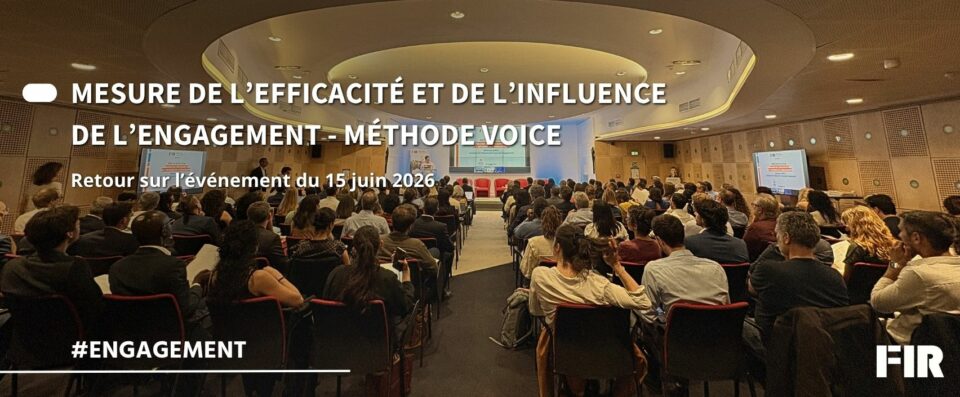
    Retour sur le lancement de la méthode VOICE : mesurer l’efficacité et l’influence de l’engagement

    Le lundi 15 juin 2026 s’est déroulé l’événement de présentation de la méthode VOICE (Valuation Of Influence in Corporate Engagement), un outil développé pour aider les investisseurs à mesurer l’efficacité et l’influence de leur engagement. Cette méthode est l’aboutissement de plus d’un an de travaux entre praticiens et académiciens, coordonnés par le FIR.

    La présentation s’est articulée autour de plusieurs temps forts :

    • Une introduction croisée de Mickaël Hellier (Responsable investissement responsable chez CDC Croissance), Régis Pelissier (Directeur de l’ERAFP) et Pierre-Olivier Billard (Directeur financier au FRR), centrée sur les enjeux fondamentaux et la crédibilité de l’engagement.

    Face au risque d' »engagement-washing », l’Investissement Socialement Responsable doit prouver son impact. L’engagement ne peut pas être une simple posture marketing, c’est le moyen le plus influent pour faire changer les entreprises, mais pour être crédible, cette activité chronophage a besoin d’un cadre rigoureux.

    • La présentation de la méthode VOICE : la « boite à outils », par Jean-Pascal Gond (professeur à la Bayes Business School) et François Humbert (engagement lead manager chez Generali AM).

    Fruit d’un travail entre praticiens et académiques, le rapport est conçu pour être approprié par tous facilement. La méthode VOICE fournit les outils pour dépasser la simple accumulation de données, notamment en distinguant 4 outils : la comptabilité, l’évaluation de l’influence, le reporting et l’évaluation des ressources pour l’engagement ESG. L’enjeu est d’évaluer l’influence sur 5 niveaux, tous complémentaires : pas d’influence, influence non démontable, influence probable, influence très probable, influence reconnue. Le but final est ainsi de pouvoir mesurer la qualité de la contribution.

    • La table ronde : la méthode VOICE sur le terrain.

    Animée par Hugh Wheelan, la table ronde a réuni Héloïse Courault (Senior Corporate Governance & Stewardship Analyst chez BNPPAM), Anne-Claire Imperiale (Directrice durabilité chez Sycomore AM), Karine Leymarie (Responsable expertises investissements et finance durable à la MAIF) et Sébastien Thevoux-Chabuel (Executive PhD Student à l’Université Paris Dauphine) pour confronter la méthode VOICE à la réalité opérationnelle des investisseurs et plus largement des engagers.

    Quelle est la valeur ajoutée d’une stratégie d’engagement ? Qu’est-ce que le rapport va pouvoir démontrer ? Qu’y a-t-il dans le rapport pour évaluer et comparer concrètement les pratiques des différents « engagers » ? Quelles recommandations du rapport sont simples à appliquer, et lesquelles représentent un vrai défi sur le terrain ? 

    • Un mot de conclusion par la présidente du FIR, Aurélie Baudhuin, qui a insisté sur l’importance d’un cadre commun et a fait un joli clin d’œil au bac de philosophie qui se déroulait le jour-même : « Débattre, est-ce chercher la vérité ? ». Une question à laquelle les travaux de la méthode VOICE tendent à répondre par l’affirmative.

    Le FIR remercie l’ensemble des intervenants, les membres du groupe de travail qui ont rendu cette publication possible, ainsi que le FRR et la Caisse des Dépôts pour l’organisation de cet événement et leur accueil.

    15 juin 2026

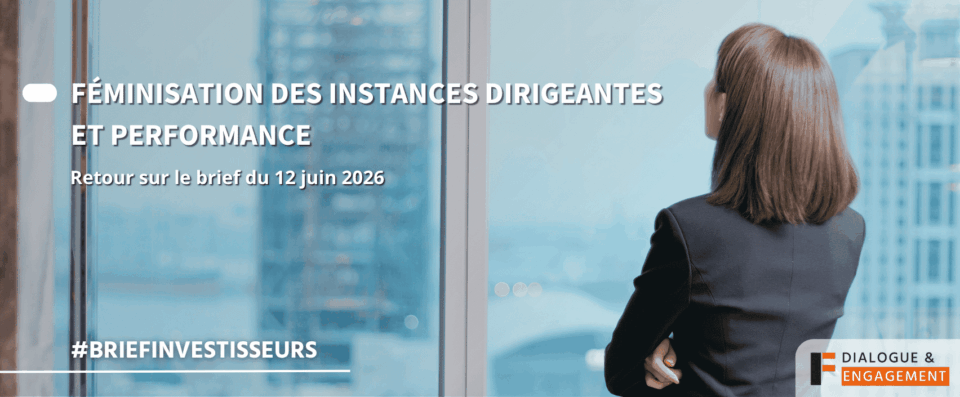
    Féminisation des instances dirigeantes et performance – retour sur brief investisseurs

    47 % de femmes dans les conseils d’administration du CAC 40 mais à peine 28 % dans les COMEX. Loi Copé-Zimmermann, loi Rixain, directive européenne « Woman on Boads » : en l’espace d’une décennie et demie, le droit a profondément réorganisé la composition des conseils d’administration en France et en Europe. Si la loi a fait bouger les lignes ces dernières années, la parité peine encore à s’imposer dans les postes opérationnels et financiers.

    Demeure une question essentielle : la féminisation des instances dirigeantes constitue-t-elle un levier de performance extra-financière et financière, ou reste-t-elle, dans la pratique, principalement symbolique ? Ce vendredi 12 juin, le FIR a organisé un brief investisseurs à destination de ses membres pour explorer ce questionnement.

    Les échanges se sont articulés autour de plusieurs prises de parole :

    • Viviane de Beaufort, professeure à l’ESSEC et personnalité qualifiée du FIR, a présenté la méthodologie et les conclusions de son étude « Féminisation des Boards et Performance ESG », décryptant notamment le syndrome de minorité et la nécessité de ne pas enfermer l’ESG dans une « case ».
    • Myriam Cohen-Welgryn, présidente internationale, division beauté dermatologique et membre du Comité Exécutif de l’Oréal, a partagé son vécu terrain et les tendances de ces dernières années, rappelant l’importance vitale de créer un vrai « espace d’expression » une fois le seuil de mixité atteint.
    • Emilien Guilbaud, analyste ESG chez Exane AM, a détaillé l’approche du Club 30 %, démontrant que la féminisation n’est pas un hasard : c’est un indicateur de la qualité de gestion du risque, d’innovation et de gouvernance.

    Un grand merci à nos trois intervenants cet échange !

    8 juin 2026

    Le FIR lance la méthode VOICE : première méthode d’évaluation de l’efficacité et de l’influence de l’engagement

    À l’issue de plus d’un an de travaux soutenus, le FIR publie la première version de la méthode VOICE (Valuation of Influence in Corporate Engagement), méthode d’évaluation de l’efficacité et de l’influence de l’engagement actionnarial et obligataire.

    En cohérence avec leur approche d’investisseurs de long terme, les investisseurs responsables prennent position sur des enjeux de préservation de l’environnement, d’équité sociale et de gouvernance (ESG). Par conséquent, ils cherchent à influencer les entreprises pour qu’elles améliorent leurs pratiques et fassent évoluer leurs modèles économiques vers plus de durabilité : c’est ce que ces travaux désignent comme « l’engagement ».

    Aujourd’hui, cet essor accéléré des initiatives d’engagement actionnarial et obligataire s’accompagne d’un besoin croissant de transparence, de mesure et d’harmonisation.

    Cette nouvelle méthode « VOICE » élabore les bases solides d’un cadre de référence visant à favoriser une meilleure compréhension de la pratique de l’engagement et valoriser les engagements de qualité influençant réellement et durablement les entreprises.

    La méthode s’articule autour de quatre outils concrets et standardisés permettant de :

    1. clarifier la comptabilité des engagements ESG (qu’est-ce qui constitue un engagement ?) ;
    2. évaluer la probabilité d’influence d’un engagement selon une gradation proposée en cinq niveaux (comment évaluer sa contribution ?) ;
    3. rendre compte des pratiques d’engagement ESG (comment reporter ?) ;
    4. identifier et mobiliser les ressources nécessaires à la mise en œuvre d’engagements de qualité (quelles ressources mobiliser pour un engagement de qualité ?)


    French SIF
    Résumé de la politique de confidentialité

    Ce site utilise des cookies afin que nous puissions vous fournir la meilleure expérience utilisateur possible. Les informations sur les cookies sont stockées dans votre navigateur et remplissent des fonctions telles que vous reconnaître lorsque vous revenez sur notre site Web et aider notre équipe à comprendre les sections du site que vous trouvez les plus intéressantes et utiles.